
Warnings and Cautions
The alert symbols, signal words (DANGER, WARNING and CAUTION) and statements throughout this manual indicate the potential severity of a situation. Ensure to read, understand and follow each statement to avoid vehicle damage, component damage, personal injury, severe injury and/or death.
The NOTICE and Note statements throughout this manual provide additional details required to avoid damaging a component or incorrectly completing a repair. Ensure to read, understand and follow each statement to properly complete a repair.
Note: Indicates additional detail that will aid in the repair of a component.
While working on a vehicle:
Compressed Air System
Before starting a vehicle:
- Sit in the driver’s seat.
- Confirm vehicle parking brake is applied.
- Confirm Neutral is selected on the driver interface device.
- Ensure vehicle has adequate fuel level.
- Do not operate the vehicle if the Alternator lamp is on or if gauge indicates low voltage with the engine running.
When parking the vehicle or leaving the cab:
- Safely come to a complete stop.
- Continue to depress and hold service brake.
- Select Neutral on the driver interface device.
- Apply vehicle parking brake.Warning
- Turn ignition key Off and allow the engine to shut to down.
Before working on a vehicle or leaving the cab with engine running:
- Safely come to a complete stop.
- Continue to depress and hold service brake.
- Select Neutral on the driver interface device.
- Apply vehicle parking brake.Warning
- Chock wheels.
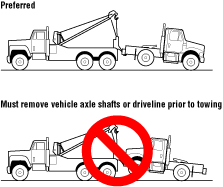
To avoid damage to the transmission during towing:
When towing a vehicle equipped with the Endurant Series Transmission, do not allow the output shaft of the transmission to rotate. If the vehicle is towed with the drive wheels still in contact with the road surface, the vehicle axle shafts or driveline must be removed or disconnected prior to towing vehicle.
After completing a transmission service procedure, ensure to complete the Configure Transmission Control Module (TCM) and/or Transmission Service Routines when directed.
Limited Driveline - Connected Towing
In an urgent situation, the vehicle may be towed after specific vehicle and transmission requirements are met at a limited road speed and distance with the driveline connected and the drive wheels in contact with the road surface.
Vehicle and Transmission Requirements:
- Vehicle air pressure greater than 90 psi (620 kPa)
- Neutral (N) selected on the vehicle’s transmissions shift device
- Solid neutral (N) indicated in the vehicle’s transmission shift device display
- Solid neutral (N) indicated in the vehicle’s transmission gear display
- Key off
Limited Towing Speed and Distance Requirements
- Road speed less than 25 mph (40 km/h)
- Distance less than 0.25 mile (0.40 km)
Configure Transmission Control Module (TCM)
Perform Configure Transmission Control Module (TCM) after completing the following component replacement procedures:
- Transmission assembly replacement
- MTM assembly replacement
- TCM assembly replacement
Transmission Service Routines
Perform Transmission Service Routines when advised by Eaton Cummins and after completing the following procedure:
- New Replacement Transmission Control Module - Perform Grade Sensor Calibration
- Mechatronic Transmission Module (MTM) - XD MTM Service Removal Utility.
Clutch and Rail Calibration
To ensure proper operation, the TCM, clutch, MTM and transmission require a Clutch and Rail Calibration. Calibrations are required after:
- Linear Clutch Actuator (LCA) replacement or re-installation
- Transmission replacement or re-installation (anytime the transmission is re-installed regardless of the service procedure performed)
- New Transmission Control Module (TCM) installation
Calibrations are automatically initiated when:
- “CC” in gear display
- LCA is in the reset position (or new TCM)
- Transmission in “N” (Neutral)
- Key on engine running
- Vehicle air system pressure at operating range