
Transmission Service Light Status Test
Overview
This symptom-driven test is performed to identify transmission service light issues.
Detection
- Transmission Service Light is on constantly.
- Transmission Service Light never illuminates.
Possible Causes
- Vehicle Shift Device Wiring
- Bent, spread, corroded or loose terminals
- Wires grounded, open or shorted
- Vehicle Shift Device
- Internal failure
- TECU
- Internal Failure
Transmission Service Light Status Test
Key on with engine off.
Connect ServiceRanger.
If ServiceRanger is unable to communicate with the TECU, go to Power-Up Sequence
If ServiceRanger can communicate with the TECU Go to Step B
Key on with engine off.
Connect ServiceRanger.
Retrieve and record the transmission fault codes and FMIs, and their occurrences and timestamps.
If Fault Code(s) 13, 14, 15, 84 and/or 85 are Active or Inactive, troubleshoot the fault code(s) per the Fault Code Isolation Procedure Index.
If Fault Code(s) 13, 14, 15, 84 and/or 85 are not set, Go to Step C
Identify if the shift device is an OEM-built device or an Eaton built device.
If the vehicle is equipped with an Eaton built shift device, Go to Step D
If the vehicle is equipped with an OEM shift device, Go to Step G
Key off.
NoticeKey on with engine off.
Observe Service Light during the key on sequence.
If the Service Light illuminates for 1 second, then turns off, test complete. Go to Step V.
If the Service Light never illuminates and the vehicle is equipped with an Eaton Push Button Shift Control Device, pull fault codes with ServiceRanger and troubleshoot the Active fault code per the Fault Code Isolation Procedure Index.
If the Service Light never illuminates and the vehicle is equipped with an Eaton built Shift Lever, Go to Step F
If the Service Light is on constantly and the vehicle is equipped with an Eaton built Shift Lever, Go to Step E
If the Service Light is on constantly and the vehicle is equipped with an Eaton Push Button Shift Control Device, replace the TECU. Go to Step V
If the Service Light flashes, pull fault codes with ServiceRanger and troubleshoot the Active fault code per the Fault Code Isolation Procedure Index.
Key off.
Note: Allow 2–3 minutes for the TECU to perform a complete power-down sequence before proceeding.
Disconnect 38-Way Vehicle Harness Connector from TECU.
Disconnect the 8-Way Shift Lever Connector.
Measure resistance between 8-Way Shift Lever Harness Connector Pin 4 and Pin 6. Record reading(s) in table.
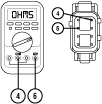
Compare reading(s) in table.
If readings are in range, replace Eaton built Shift Lever. Go to Step V
If readings are out of range, repair or replace wiring between the TECU and Shift Lever per OEM guidelines.Go to Step V
| Pins | Range | Reading(s) |
|---|---|---|
| 4 to 6 | Open Circuit (OL) |
Key off.
NoticeDisconnect the 8-Way Shift Lever Connector.
Key on with engine off.
Measure voltage between 8-Way Shift Lever Harness Connector Pin 6 and Pin 3 while turning the key on. Record reading(s) in table.
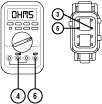
Compare reading(s) in table.
If readings are in range, replace Eaton built Shift Lever. Go to Step V
If readings are out of range, repair or replace wiring between the TECU and Shift Lever per OEM guidelines. Go to Step V
| Pins | Range | Reading(s) |
|---|---|---|
| 6 to 3 (first second after key on) | Within 2.0 V of Battery Voltage | |
| 6 to 3 (after 1 second) | Less than 1.5 V |
Key off.
NoticeDisconnect 38-Way Vehicle Harness Connector from TECU.
Note: See OEM wiring diagram and connector views to identify the Service Light Power and Ground Pins at the Service Lamp in the dash.
Inspect wiring between the TECU and Service Lamp for signs of rubbing or chafing to the wiring.
Inspect connector bodies for corrosion, damage and loose, spread or bent terminals.
Contact the OEM to perform the following tests:
Note: The transmission sends a voltage to the 38-Way Vehicle Harness Pin 23 to light the Service Lamp. The OEM is responsible for supplying the Service Lamp ground.
Note: Some OEM chassis use a switched ground to control the Service Lamp, rather than the switched voltage that the TECU is sending. Those chassis may use a relay, or another technique, to replace the TECU Service Lamp output voltage with a ground signal.
Verify that the wiring between the TECU and the Service Lamp is wired per OEM specifications.
Verify the wiring is not open or shorted to ground.
Verify a proper ground path is supplied to the Service Lamp.
Refer to OEM guidelines for repair or replacement of vehicle wiring and or transmission service light. Go to Step V
Key off.
Reconnect all connectors and verify that all components are properly installed.
Key on with engine off.
Clear fault codes using ServiceRanger.
Drive vehicle and attempt to reset the code or duplicate the previous complaint.
Check for fault codes using ServiceRanger.
If no fault codes set Active during the test drive and vehicle operates properly, test complete.
If a fault code is set Active during the test drive, troubleshoot per Fault Code Isolation Procedure Index.
If no fault codes set Active and the vehicle complaint is duplicated, refer to Contact Information and contact Eaton for further diagnostics.